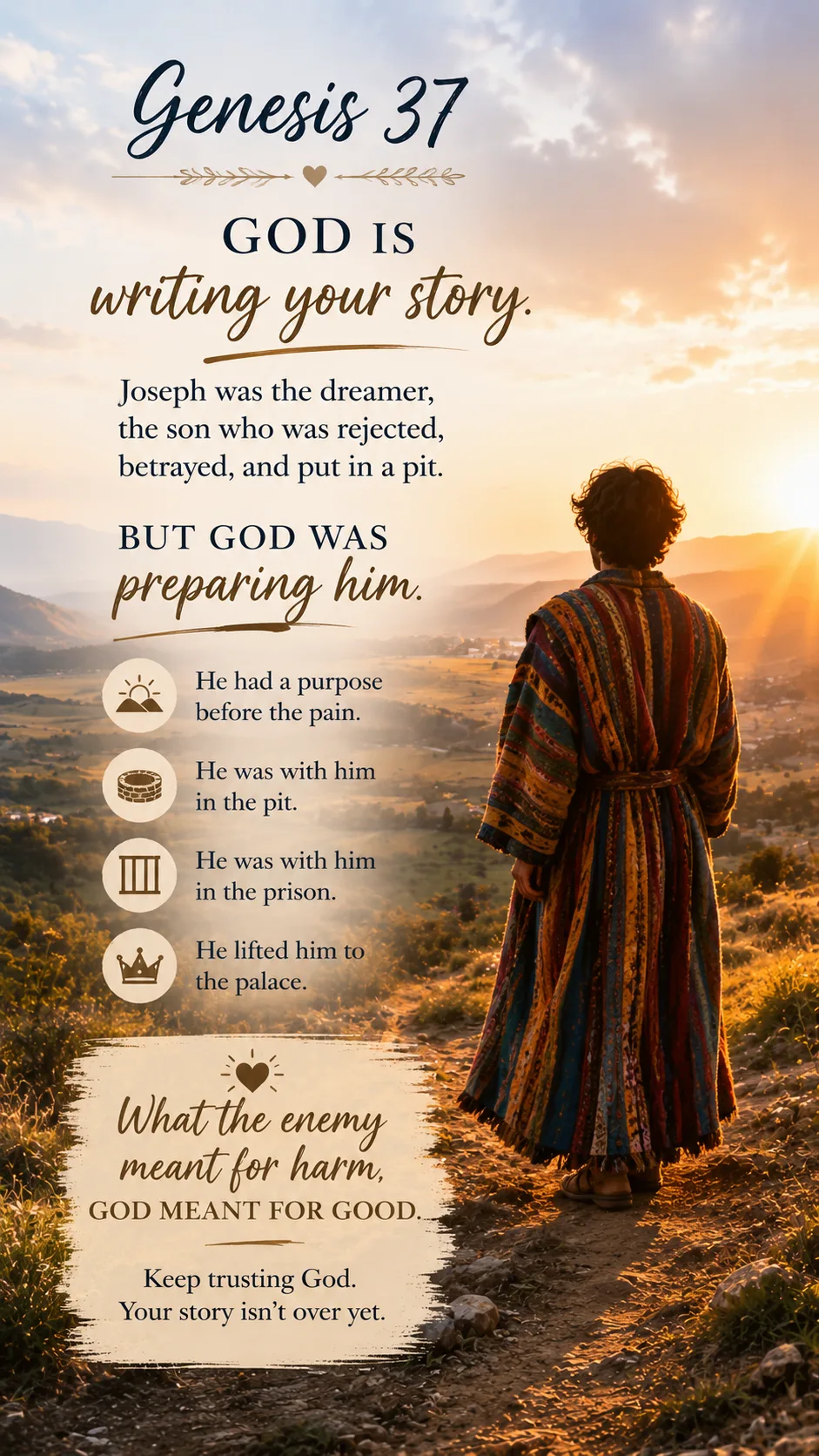
There are seasons in life that feel like a pit.
Not metaphorically. Actually like a pit — like you've been thrown down into a dark place by circumstances or people you trusted and you're sitting there in the bottom of it wondering how you got here and whether anything is ever going to change. You had a dream. You had a direction. You had a sense that God was up to something in your life. And then everything went sideways and now you're in the pit wondering if any of that was real.
If that's where you are right now this devotional is for you. Because Joseph has been there. And his story — starting in Genesis 37 and running all the way through to Genesis 50 — is one of the most powerful testimonies in all of Scripture about what God does when everything seems to be going wrong.
I've driven through some dark stretches on the road where the metaphorical pit felt very real. Seasons where the dreams I was building felt further away than ever, where people I trusted let me down, where I couldn't see how any of the broken pieces were going to come together into anything good. Joseph's story kept me going through more than one of those seasons. And I believe it'll do the same for you.
What Is Genesis 37 About?
Genesis 37 opens the story of Joseph — the eleventh son of Jacob, the favorite of his father, the dreamer who saw in a vision that his brothers would one day bow down to him. It ends with Joseph at the bottom of a pit in the wilderness, sold by his own brothers to a caravan of Midianite merchants heading to Egypt, while his father is told his beloved son is dead.
In between those two points is one of the most gut-wrenching chapters in the entire Bible. Jealousy. Betrayal. The stripping of the coat of many colors. The cold calculation of brothers who could eat a meal while their youngest sibling cried out from the pit they had thrown him into.
From a human perspective Genesis 37 looks like a story of dreams destroyed. From God's perspective it looks entirely different.
That gap — between what things look like from the ground and what God is actually doing from above — is the entire lesson of Joseph's life. And it's the lesson that will sustain you through your own pit seasons if you let it.

Verse by Verse — Genesis 37 Devotional Breakdown
Verses 3-4 — "Now Israel loved Joseph more than any of his other sons..."
The story begins with favor and the resentment that favor can produce. Joseph didn't ask to be his father's favorite. He didn't earn the coat of many colors through some achievement. It was given to him. And that gift became the thing that made his brothers despise him.
There's something worth sitting with here for anyone who has ever been resented for a gift they didn't ask for. Being favored by God — having a calling on your life, a dream He placed in you, a gift that sets you apart — doesn't protect you from the jealousy of people around you. Sometimes it provokes it.
Joseph wasn't doing anything wrong. He was just being who he was. And it cost him.
Verses 5-11 — The Dreams
Joseph has two dreams. In the first one his brothers' sheaves of grain bow down to his sheaf. In the second the sun, moon and eleven stars bow down to him. His brothers hated him even more. Even his father rebuked him, though the text says Jacob kept the matter in mind.
Here's what I want you to notice. God gave Joseph these dreams before He allowed Joseph to go through the pit. The dream came before the suffering. The vision came before the valley. That's not an accident. God gave Joseph a picture of the destination before He walked him through the process of getting there — because the process was going to be brutal and Joseph was going to need something to hold onto in the dark.
If God has placed a dream in you — a vision for your life, a sense of calling, something He put in your heart that hasn't happened yet — hold onto it. The gap between the dream and the fulfillment is not evidence that God was wrong. It's often where the most important formation happens.
Verses 18-24 — The Pit
When Joseph arrives at Dothan looking for his brothers their first instinct is to kill him. Here comes that dreamer, they say. Reuben intervenes and talks them out of murder — but before he can act the other brothers pull Joseph out of the pit and sell him to the Midianite merchants for twenty pieces of silver.
There is a detail in verse 24 that has always stopped me. It says the cistern was empty — there was no water in it. Joseph is not going to drown. He is going to sit in the dark at the bottom of a dry hole in the ground listening to his brothers eat their meal above him, hearing them negotiate the price of his life, waiting to find out what happens next.
He is completely helpless. Completely alone. Everything he thought his life was going to be has just been stripped away in a single afternoon.
And the text doesn't record a single word from Joseph. Not a prayer. Not a declaration of faith. Just silence and darkness and the sound of his brothers eating above him.
Sometimes the pit is just quiet. And that's okay. God is still there.
Verse 28 — Sold Into Egypt
Twenty pieces of silver. That's what Joseph's brothers valued his life at. He is stripped of his coat — the symbol of his father's favor — and handed to strangers heading to a foreign country where he knows no one and nothing.
From every human angle this is the end of the story. The dreamer is gone. The dreams are dead. The favorite son has been reduced to a slave being marched toward Egypt.
But we know something Joseph didn't know in that moment — this road to Egypt is the road to the fulfillment of everything God promised him. The pit wasn't the end. The pit was the path.
Genesis 39 — God Was With Joseph in Egypt
The story doesn't end in the pit. Genesis 39 picks up with Joseph in Egypt, working in the house of Potiphar, and one of the most repeated phrases in the entire Joseph narrative appears for the first time.
"The Lord was with Joseph."
Not in the palace. Not after the promotion. In the house of a foreign official where Joseph was working as a slave. The Lord was with him. And because the Lord was with him he prospered. Then Potiphar's wife falsely accuses Joseph and he ends up in prison. And the phrase appears again — "but while Joseph was there in the prison, the Lord was with him."
Do you see the pattern? Every time Joseph ends up in a new pit — the cistern, slavery in Egypt, prison — the text immediately says the Lord was with him. Not after the pit. Not when things got better. In the pit.
God's presence wasn't dependent on Joseph's circumstances being good. It was constant. Consistent. Faithful in every dark place Joseph found himself.
That truth is for you today if you are in a pit season. The Lord is with you. Not when things get better. Right now. In this.
Genesis 50:20 — The Verse That Changes Everything
Years later — after the pit, after Egypt, after prison, after an extraordinary series of events that only God could have orchestrated — Joseph is face to face with the brothers who sold him. He has the power to destroy them. He has every human reason to.
And instead he says this, in one of the most powerful statements in all of Scripture:
"You intended to harm me, but God intended it for good to accomplish what is now being done, the saving of many lives."
You intended to harm me. But God intended it for good.
Joseph doesn't minimize what his brothers did. He acknowledges it directly — you intended harm. But he also acknowledges something bigger — God had a different intention running through the same events. What the brothers meant for destruction God was using for deliverance.
I don't know what your pit looks like right now. But I know this verse is true because I've seen it be true. The things that felt like they were destroying what God had for me were often the very things God was using to build it. Not despite the hard seasons. Through them.
What the Joseph Story Means for Your Daily Life
The story that runs from Genesis 37 through Genesis 50 is the longest continuous narrative in the book of Genesis. God gave us fourteen detailed chapters because He knew we would need it.
We would need to see that the pit is not the end. That the Lord is with us in prison, not just in the palace. That the people who meant us harm don't get the final word over our lives. That the dreams God places in us don't die in the pit even when everything looks like they did.
If you are in a pit season right now — hold onto the dream. Stay faithful in the small place you're in. Genesis 39 shows us that Joseph worked faithfully as a slave and as a prisoner, not knowing when or if things would ever change. That faithfulness in obscurity was what prepared him for the platform.
Your pit season is not wasted. God is with you in it. And He is working — even now, even when you can't see it.
You intended to harm me. But God intended it for good.

For more on trusting God through the waiting and the hard seasons, the Psalm 27 devotional is where I go when the pit feels the most suffocating — David's declaration that he will see the goodness of the Lord in the land of the living. And the Psalm 139 devotional speaks directly to the feeling of being unseen and invisible that so often comes with pit seasons.
A Simple Prayer Based on Genesis 37 and 50:20
Lord, I confess that from where I'm standing right now the pit looks like the end of the story. Help me to see what Joseph eventually saw — that You were present in every dark place, that You were working through every betrayal, that nothing that has been done to me has the power to derail what You intend for my life. Give me the faithfulness to be present and obedient in the small place I'm in right now while I trust You with the bigger story. You intended it for good. I choose to believe that today. Amen.
One of the things I built into FaithSpark was a devotional experience that meets you in exactly the kind of season you're in — not a generic verse for the day but something that speaks to where you actually are. On the mornings when you're in the pit and you need to be reminded that God is still present and still working, the app is there to anchor you in that truth.
Browse more devotionals on the FaithSpark blog or visit faithspark.app to learn more or download the app now on iOS or Android.