Most of us learned John 3:16 before we learned to drive.
We saw it on signs at football games. We heard it in Sunday school with hand motions. We memorized it for Vacation Bible School and won a piece of candy. It became the shorthand for the entire gospel — the bumper sticker verse, the end zone sign, the verse that everybody knows whether they go to church or not.
And somewhere in the familiarity we stopped actually hearing it.
I did too. For years John 3:16 was background noise to me — something I could recite without thinking, something I nodded at when it came up in a sermon, something I assumed I had already gotten everything out of. I knew it the way you know your own phone number. By reflex. Not by conviction.
Then one morning I was sitting in my truck before a long haul and I decided to read it slowly. Not fast. Not to get to the next verse. Just to sit with each word and let it actually land.
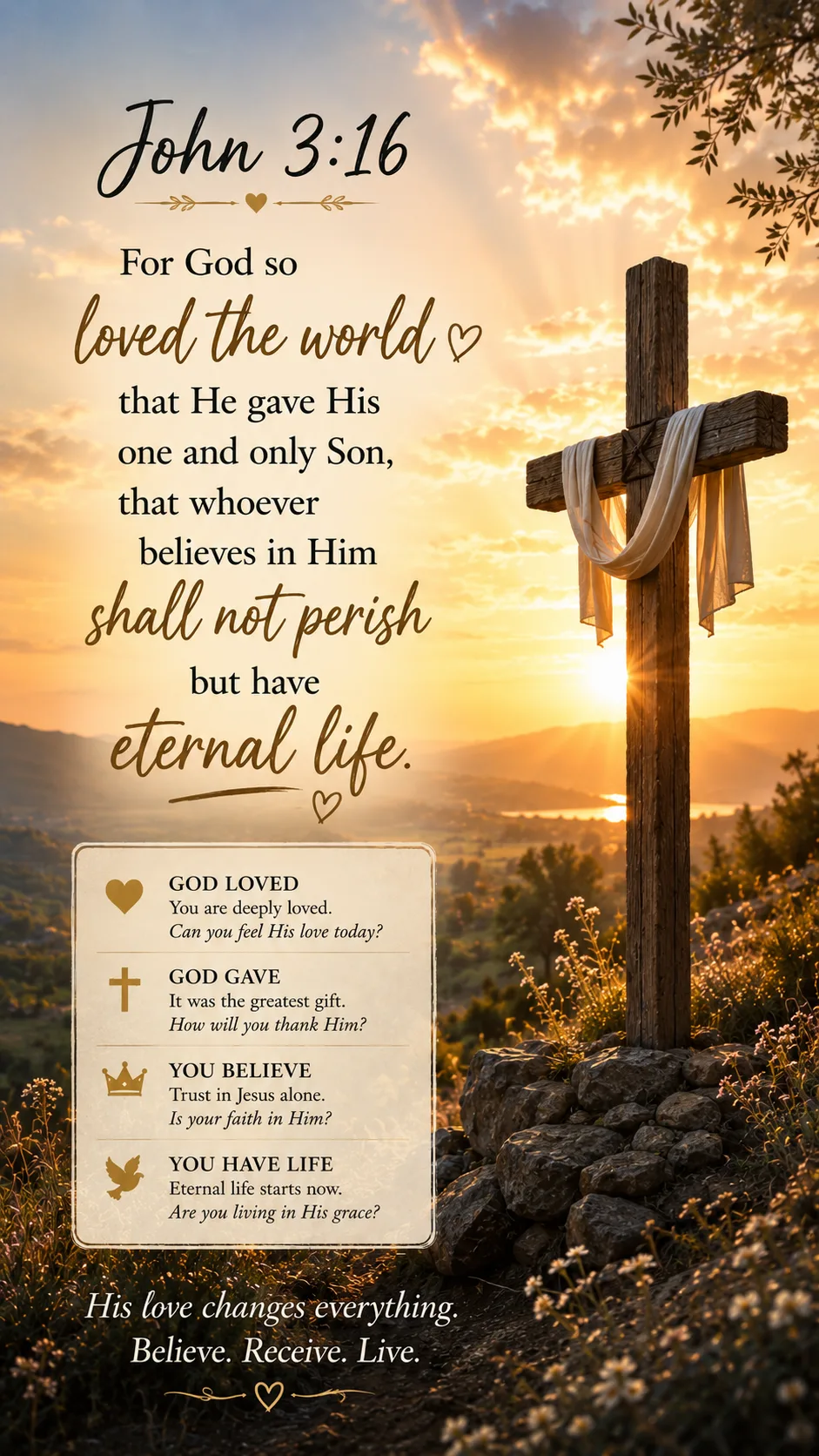
For God so loved the world that he gave his one and only Son that whoever believes in him shall not perish but have eternal life.
Twenty-six words. And I sat there for twenty minutes because every single one of them hit differently when I actually stopped to think about what they meant.
This John 3:16 devotional is about doing that together. Slowing down the most famous verse in the Bible and letting it speak to you like you've never heard it before.
What Is John 3:16 About?
John 3:16 sits in the middle of a nighttime conversation between Jesus and a Pharisee named Nicodemus. Nicodemus comes to Jesus after dark — probably because he doesn't want to be seen — and Jesus begins to teach him about being born again, about the Spirit, about the Kingdom of God.
And then in verse 16 Jesus says something that has echoed across two thousand years of human history as the clearest and most complete summary of the gospel ever spoken.
It is not a complicated verse. But it is a deep one. And most of us have been reading it shallow for years.

Word by Word — John 3:16 Devotional Breakdown
"For God"
The verse starts with God. Not with us. Not with our sin or our need or our effort. With God.
That's not a small thing. The entire orientation of the gospel is God acting toward us — not us reaching up toward God. Before we did anything, before we knew we needed saving, before we were even born — God was already moving.
Every devotional, every prayer, every moment of faith starts here. Not with what we bring to God but with who God already is and what He has already done. For God. It starts with Him.
"So Loved"
The word so in English is doing enormous work here and most people glide right past it.
In the original Greek the word is houtōs — it means in this way, to this degree, in this manner. Jesus is not just saying God loved the world. He is saying look at how God loved. Look at the manner and the measure and the method of it.
The so points forward to everything that comes next — the giving of the Son, the cross, the resurrection. That is how God loved. That is the degree of it. That is what love looks like when God is doing the loving.
The love of God is not a feeling He has about you. It is an action He took toward you at enormous cost to Himself. And the so tells you how far He was willing to go.
"The World"
Not the righteous. Not the people who had it together. Not the people who were already seeking Him. The world.
The Greek word is kosmon — the whole inhabited world. Every person. Every nation. Every generation. Including people who would reject Him. Including you on your worst day and me at my most faithless and everyone who has ever made a mess of their life and wondered if they had gone too far.
I need to say something directly to anyone reading this who has a quiet voice in the back of their head saying that verse is true for most people but maybe not for you. Maybe you've done too much. Maybe you've been away too long. Maybe the mess you've made is too complicated for a verse that simple to cover.
The world means you. There are no exceptions in that word. None.
"That He Gave"
Love acted. Love moved. Love gave.
The word gave here is edōken in Greek — a completed action at a specific point in time. God gave. It happened. It is done. The gift has been given and it cannot be taken back.
The nature of what God gave is important too. He gave His one and only Son. The Greek word monogenē means one of a kind, unique, the only one of its kind. This was not a small gift given from abundance. This was the most precious thing in existence given at the highest possible cost.
A father giving his only son. I have children. I can't get through that phrase without it hitting me somewhere very deep. There is no greater cost. And God paid it. For the world. For you.
"That Whoever Believes in Him"
Whoever.
Not whoever has been good enough. Not whoever has attended enough church services. Not whoever has their theology exactly right. Whoever believes.
The Greek word pisteuōn means to trust, to have faith in, to rely upon. It is not primarily an intellectual agreement. It is a reliance. A leaning. A coming to Jesus with the weight of your life and trusting Him to hold it.
That is the condition. Not perfection. Not performance. Whoever believes. Whoever trusts. Whoever comes.
"Shall Not Perish"
Jesus is talking about something real here. Perishing. Separation from God. The consequence of a life lived apart from the One who made you and loves you.
He doesn't minimize it. He names the alternative directly — and then He tells you how to avoid it.
The negative construction in the Greek is emphatic — ou mē — a double negative meaning absolutely will not, under no circumstances, cannot. Whoever believes in Him shall absolutely not perish. This is not a maybe or a probably. It is a guarantee from the mouth of Jesus.
"But Have Eternal Life"
Eternal life in Scripture is not primarily about duration — living forever. It is about quality — living in relationship with God. Jesus defines it in John 17:3 — this is eternal life, that they know you, the only true God, and Jesus Christ whom you have sent.
Eternal life is knowing God. It starts now, not when you die. The life that John 3:16 offers is not a consolation prize you collect at the end. It is the life you can start living today. Right now. In this season, in whatever ordinary Tuesday you're in.
What John 3:16 Means for Your Daily Life
You probably already knew John 3:16. You can probably still recite it from memory. But knowing a verse and letting it actually reach you are two different things.

The love of God described in those twenty-six words is not a theological concept for Sunday mornings. It is the most important reality about your life right now. Before you were a parent or a spouse or an employee or a failure or a success — you are someone God so loved. Someone He gave everything for. Someone the whoever includes specifically and without exception.
If slowing down the Psalms connects with you too, the Psalm 34 devotional does the same thing with David's powerful invitation to taste and see that the Lord is good — another verse most people know by memory but haven't fully received. And the John 14:27 devotional walks through Jesus' gift of peace from the same farewell conversation with His disciples.
A Simple Prayer Based on John 3:16
God, I want to receive this verse today like I'm hearing it for the first time. You loved the world — You loved me — so much that You gave Your only Son. I am part of the whoever. I believe. I trust You with the weight of my life today. Thank You that the gift has already been given and cannot be taken back. Thank You that whoever means me — on my best days and my worst. I receive eternal life not as something I earn but as something You give. Amen.
The reason I built the daily devotional feature in FaithSpark was exactly this — to create a space every morning where Scripture slows down and actually reaches you instead of washing over you. Browse more on the FaithSpark blog or visit faithspark.app to learn more or download the app now on iOS and Android. Start each morning letting the Word actually reach you.