I don't talk about fear much. It's not really something guys in my world lead with. You get in the truck, you do the job, you handle what comes. But if I'm honest — and that's kind of the whole point of this — there have been seasons where fear was riding shotgun whether I invited it or not.
Fear about finances. Fear about whether I was being the husband and dad my family needed. Fear about whether the things I was building on the side would ever amount to anything or whether I was just wasting time and money chasing ideas that would never land. That quiet, persistent fear that doesn't announce itself loudly but just sits there in the passenger seat mile after mile.
I found Psalm 27 during one of those seasons and I've come back to it more times than I can count. It doesn't make the fear disappear overnight. But it does something better — it gives you somewhere to stand when the fear shows up.
What Is Psalm 27 About?
Psalm 27 is one of David's most beloved psalms and it's easy to see why. It opens with one of the most confident declarations in all of Scripture and ends with one of the most honest admissions — that waiting on God is hard and you have to preach it to yourself to keep going.
David wrote this psalm while facing real enemies. Not metaphorical ones. People who wanted to kill him. And yet the tone of this psalm is not panic or despair — it's a man who has learned where his stability comes from and is reminding himself of it out loud.
That's what Psalm 27 is — a man talking himself back to faith in real time. And that's exactly why it feels so alive when you read it.

Verse by Verse — Psalm 27 Devotional Breakdown
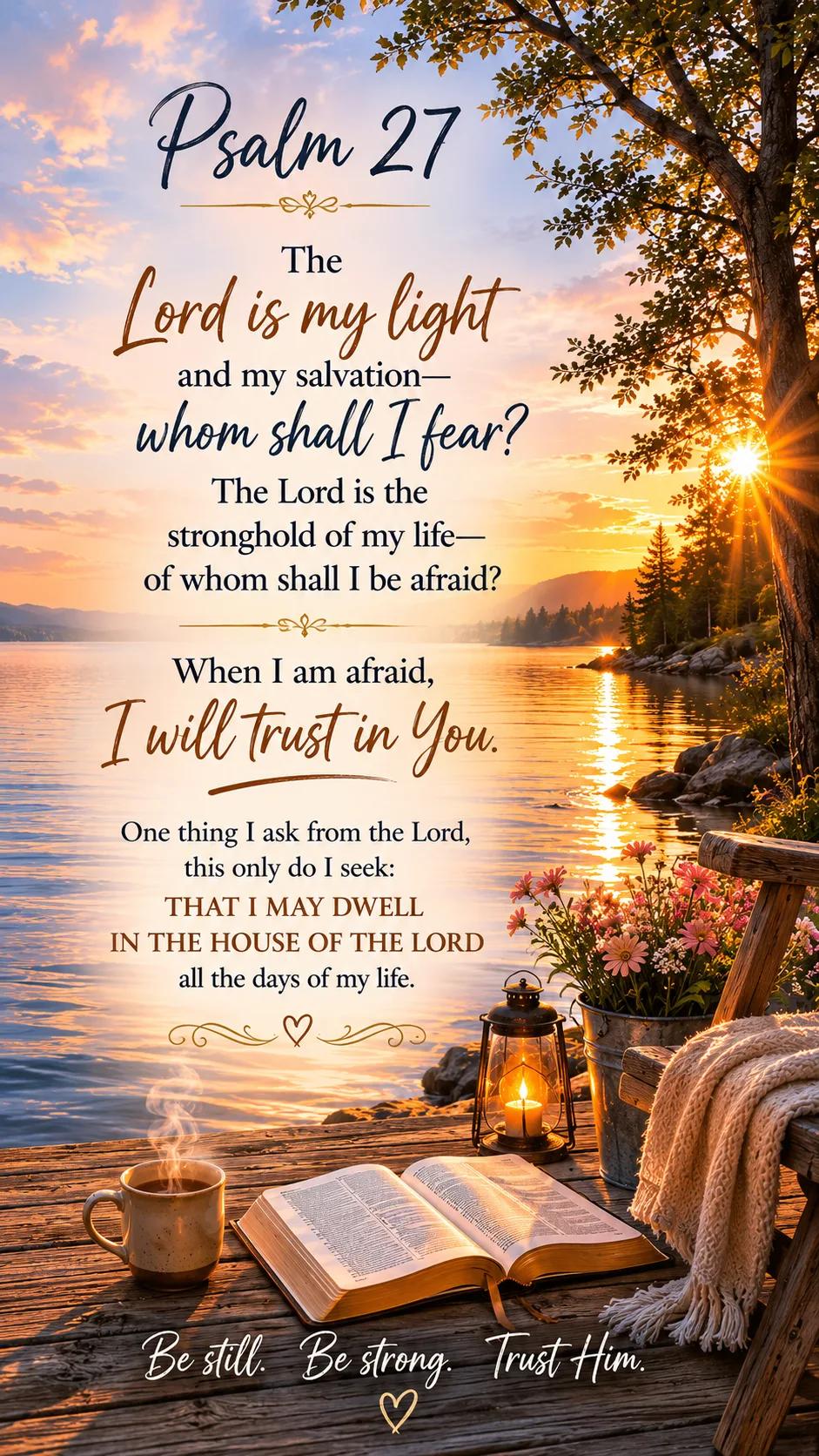
Verse 1 — "The Lord is my light and my salvation — whom shall I fear?"
David opens with two declarations and two questions. The Lord is my light — meaning God illuminates what is dark and confusing. The Lord is my salvation — meaning God is my rescue when I can't rescue myself. The Lord is the stronghold of my life — meaning God is my protection, my fortress, the place I run to when everything outside is threatening.
And then David asks — whom shall I fear? Of whom shall I be afraid?
The implied answer is nobody. Nothing. Not because David is fearless by nature but because he has put his eyes back on who God is. Fear shrinks when you get a clear view of God. It doesn't always disappear — but it shrinks.
I've had to do this on the road. Pull over. Literally say out loud — the Lord is my light. The Lord is my salvation. Whom shall I fear? It sounds simple but there's something about speaking truth out loud that shifts something in your chest.
Verses 2-3 — "Though an army besiege me, my heart will not fear."
David is describing a level of opposition most of us will never face literally. But there's a principle here that applies to every hard season — the enemies don't win. Whatever is coming against you, David is saying that when God is your stronghold the things attacking you end up stumbling, not you.
That doesn't mean life is easy. David's life was anything but easy. It means the outcome is already settled when you're under God's protection. And that changes how you face what's in front of you.
Verse 4 — "One thing I ask from the Lord, this only do I seek: that I may dwell in the house of the Lord all the days of my life."
This is the heart of the whole psalm and one of my favorite verses in Scripture. One thing. Not a list. Not a prayer strategy. One thing.
David — a man facing armies, betrayal, loss — says the one thing he wants above all else is just to be in God's presence. To dwell with Him. To see His beauty.
I think about how different my prayer life looks compared to that. How often I lead with the list — fix this, provide this, protect this — and how rarely I lead with just wanting to be near Him. David had more pressing problems than I'll ever have and his one request was presence.
That conviction sits with me every time I read it.
Verse 8 — "Your face, Lord, I will seek."
There's a beautiful detail here. David says his own heart is telling him to seek God's face. As if the deepest part of him already knows the answer before the fear even finishes its sentence. Seek His face. That's the response to every fear, every uncertainty, every season of waiting.
Not solve it. Not figure it out. Seek His face.
Verse 10 — "Though my father and mother forsake me, the Lord will receive me."
This verse is devastating in the best way. David goes to the most intimate possible human rejection — what if the people who were supposed to love you most abandon you — and says even then God receives you.
I think about the people reading this who know that feeling. Who grew up without a father or a mother who showed up the way they should have. Who have been abandoned by people they trusted. David sees you in this verse. And more importantly God sees you. He receives the rejected. He welcomes the forsaken. That's the kind of God we're talking about.
Verses 13-14 — "Wait for the Lord; be strong and take heart and wait for the Lord."
David ends this psalm not with resolution but with a command to himself. Wait. Be strong. Take heart. Wait again.
He doesn't say the hard season is over. He doesn't say God showed up and solved everything. He says I am confident I will see His goodness — and while I'm waiting I am going to be strong and I am going to keep my heart up.
That's not easy. Waiting is one of the hardest things faith asks of us. But notice David tells himself twice — wait for the Lord. As if he knows his own tendency to stop waiting and start forcing. As if he's preaching to himself because he needs to hear it.
I need to hear it too. If you're in a waiting season right now this verse is for you. Be strong. Take heart. Wait for the Lord.
What Psalm 27 Means for Your Daily Life
Here's what I keep coming back to with this psalm. David doesn't start with his circumstances. He starts with who God is. Light. Salvation. Stronghold. And everything else — the fear, the enemies, the uncertainty, the waiting — gets processed through that foundation.
That's the practice. Not pretending fear doesn't exist but choosing where you stand before you let yourself feel it. The Lord is my light. The Lord is my salvation. Now — what were we afraid of?

It doesn't always work instantly. Some mornings I have to read verse one three times before it starts to settle. But it always settles eventually because it's true — not just as a nice thought but as the actual reality of who God is and who you are to Him.
If anxiety and fear are the specific things you're dealing with and you want a resource built around that theme, Mind Garden Press has a piece on daily devotionals for anxiety and stress — and one on staying consistent with daily devotionals for the seasons when keeping the practice going is the hardest part.
If fear and waiting are themes God is working through in your life right now, I'd also encourage you to read the Psalm 139 devotional — David's powerful reflection on being fully known and seen by God even in the hardest seasons. And if praise in the middle of pain speaks to you, the Psalm 34 devotional is where David chose worship from one of his lowest points ever.
A Simple Prayer Based on Psalm 27
Lord, You are my light in every dark season and my salvation when I can't save myself. I choose today to make You my one thing — the thing I seek above every other request on my list. When fear tries to move back in I'm going to speak this psalm out loud and let it push the fear back. Give me the strength to wait when waiting is hard. Give me the courage to believe I will see Your goodness before I see the outcome. Be strong, my soul. Wait for the Lord. Amen.
One of the things I built into FaithSpark was a daily devotional that meets you in the specific season you're in — not a generic verse for the day but something personalized to how you're actually feeling that morning. On the mornings when fear is riding shotgun Psalm 27 is the kind of anchor that changes the whole day.
If you want to start your mornings grounded in Scripture like this, browse more devotionals on the FaithSpark blog or visit faithspark.app to learn more or download the app now on iOS and Android. Start the day with your one thing.